Lent Processions and Alfombras
You smell the incense before you see it. It’s sweet, piney, copal warmth. It’s moving at the perfect pace with the breeze. And to catch that scent, out in open air means it’s burning heavily, rolling through the streets like the volcanoes that frame the sky of Antigua, Guatemala.
The cobblestone streets are lined with families. Makeshift push carts of nuts and cotton candy move past you. Fresh slices of papaya are offered by traditionally dressed women, seated along the curbs. They are slicing at their ground-level kitchens. It almost feels like a carnival yet softer, slowed, and swaddled in a spiritual aura.
Then, from a distance, you see the clouds of holy incense and through that the procession, followed by the sound of dramatic music, louder with each swaying step.
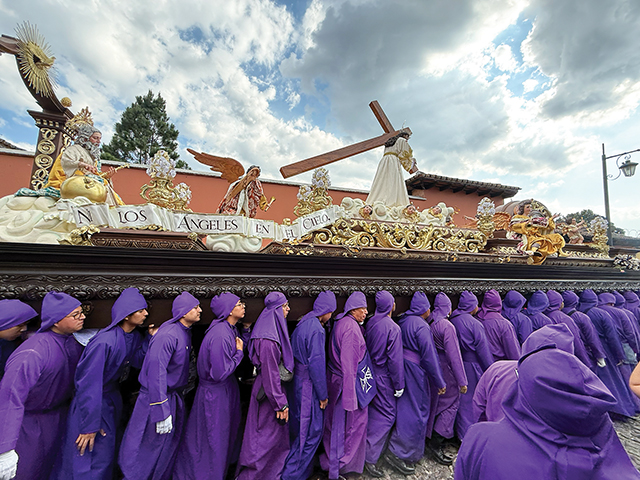
Every Sunday during Semana Santa (Lent), Antigua honors the season with elaborate processions that last through the night. Community, priests, and church folks carry statues of Jesus bearing the cross, followed by the Blessed Mother, followed by a full-on marching band. There’s an order to it—men carry the float with Jesus, women follow and carry Mother Mary. And it is an honor and a devotional display to do so.
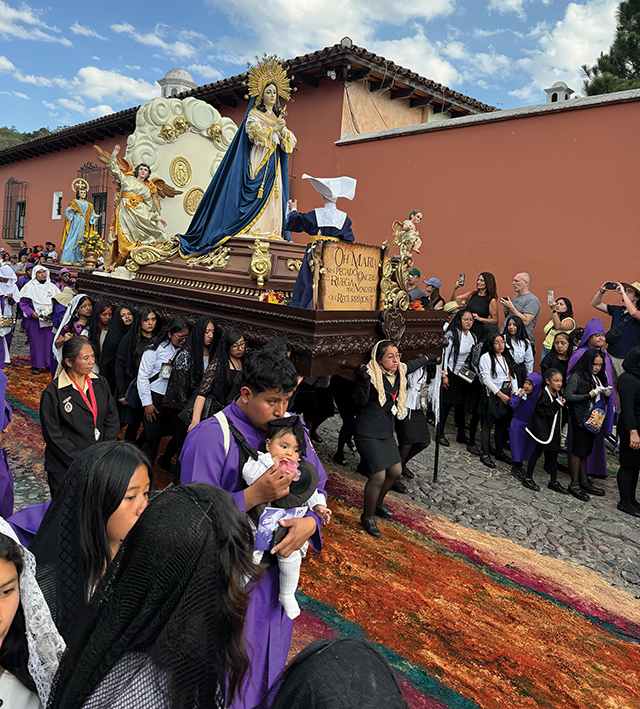
The men wear hooded purple cloaks, the mood is solemn, and the pace is steady. The women, dressed in black with lace, like widows, shoulder the weight of their massive float with grace. Seeing these women, shoulder carrying, reminded me of the heavy weight of the cross Jesus bore and the weight of my sins.
It struck me to see so many young people (teens through their 30s) wanting to be there; it wasn’t a church obligation. Catholicism is part of who these people are. It made me think about my relationship to the church and what it can look like.
The Lent processions in Antigua, Guatemala, trace back to Spanish colonial rule in the 16th century, when Catholic traditions were introduced by missionaries. These processions were designed to visually teach the story of Christ’s passion to Indigenous populations, many of whom did not speak Spanish. Over time, what began as an imposed ritual became more layered, adapted, and reinterpreted through local culture.
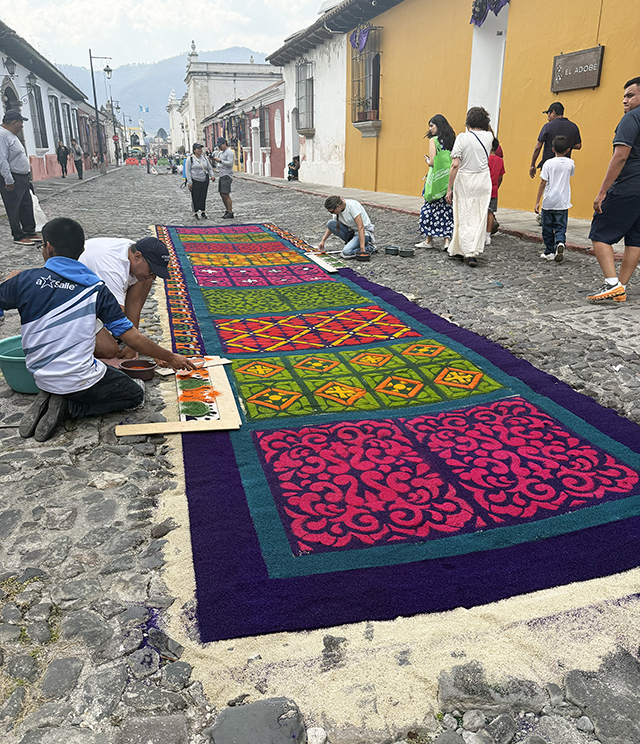
Mayan Indigenous influence is most visible in the creation of alfombras—intricate carpets made from colored sawdust, flowers, fruits, and other natural materials. Originally, they honored sacred Mayan spaces and were created for royalty or deities. The offerings drawn from the earth, rooted in a deep connection to land, color, and symbolism that long predate colonial religion.
Over time, that tradition merged with the rituals of Holy Week. Now, local families, businesses, and church groups spend hours, days, and sometimes all night creating the sawdust carpets. They are offerings. Gifts to God, laid carefully on the ground.
I was in awe of these artworks. Before the procession begins, there’s an eerie window of time when you can walk the carless streets (on Lent Sundays) and take in the intricate street carpets as they’re being made. You witness the care and intention, knowing they will be slowly, deliberately walked over by the procession. When I watched the details dissolve underfoot, it was a heart-opening, wow moment for me.
This is a ritual of impermanence. It’s a blessing to have the procession pass over the carpet your family, business, or church created. For me, I thought of Ash Wednesday and one of my favorite bible quotes: “Remember you are dust, and to dust you shall return.” (Genesis 3:19).
That first week of Lent, I texted my family group chain from Guatemala and typed out, “I’ve been in touch with the spirit.”
Happy Easter to you and yours.
For more photos and videos of the Guatemalan Lent processions and alfombras, visit my Instagram: @theglorifiedtomato.
Source: growingupbilingual.com, https://en.wikipedia.org/wiki/Sawdust_carpet