Candy Canes
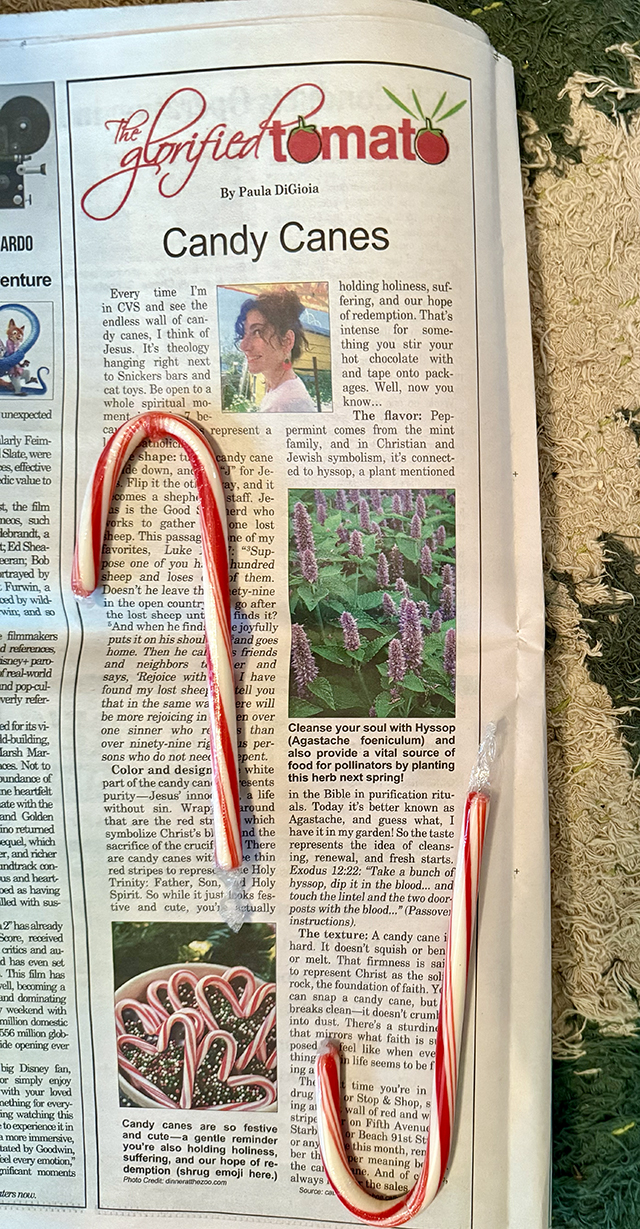
Every time I’m in CVS and see the endless wall of candy canes, I think of Jesus. It’s theology hanging right next to Snickers bars and cat toys. Be open to a whole spiritual moment in aisle 7 because candy canes represent a lot in Catholicism.

The shape: turn a candy cane upside down, and it’s “J” for Jesus. Flip it the other way, and it becomes a shepherd’s staff. Jesus is the Good Shepherd who works to gather the one lost sheep. This passage is one of my favorites, Luke 15:3-7: “(3) Suppose one of you has a hundred sheep and loses one of them. Doesn’t he leave the ninety-nine in the open country and go after the lost sheep until he finds it? (5) And when he finds it, he joyfully puts it on his shoulders (6) and goes home. Then he calls his friends and neighbors together and says, ‘Rejoice with me; I have found my lost sheep.’ (7) I tell you that in the same way, there will be more rejoicing in heaven over one sinner who repents than over ninety-nine righteous persons who do not need to repent.
Color and design: The white part of the candy cane represents purity – Jesus’ innocence, a life without sin. Wrapped around that are the red stripes, which symbolize Christ’s blood and the sacrifice of the crucifixion. There are candy canes with three thin red stripes to represent the Holy Trinity: Father, Son, and Holy Spirit. So while it just looks festive and cute, you’re actually holding holiness, suffering, and our hope of redemption. That’s intense for something you stir your hot chocolate with and tape onto packages. Well, now you know…
The flavor: Peppermint comes from the mint family, and in Christian and Jewish symbolism, it’s connected to hyssop, a plant mentioned in the Bible in purification rituals. Today it’s better known as Agastache, and guess what, I have it in my garden! So the taste represents the idea of cleansing, renewal, and fresh starts. Exodus 12:22: “Take a bunch of hyssop, dip it in the blood… and touch the lintel and the two doorposts with the blood…” (Passover instructions).

The texture: A candy cane is hard. It doesn’t squish or bend or melt. That firmness is said to represent Christ as the solid rock, the foundation of faith. You can snap a candy cane, but it breaks clean—it doesn’t crumble into dust. There’s a sturdiness that mirrors what faith is supposed to feel like when everything else in life seems to be falling apart.
The next time you’re in the drug store or Stop & Shop, staring at that wall of red and white stripes—or on Fifth Avenue, at Starbucks, or Beach 91st Street, or anywhere this month, remember the deeper meaning behind the candy cane. And of course, always look for the sales.

Source: catholicidentity.bne