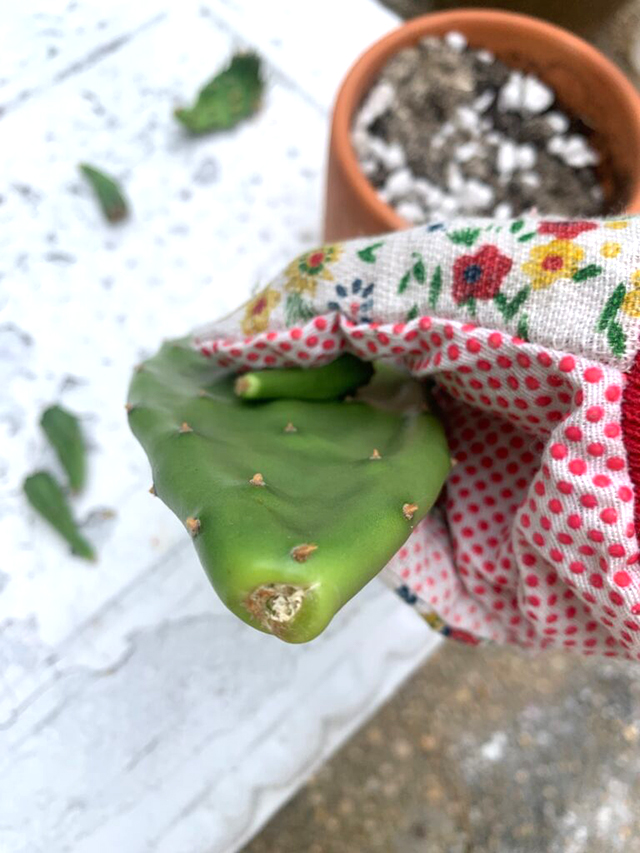
I’ve always admired prickly pear cactus for its distinctive paddle spikes, bright red buds, and showy yellow flowers. There are 181 different species. Opuntia is a perennial shrub with waxy skin. The cactus thrives in sandy soil and dry conditions. It grows wild in arid areas in the south and southwest. Opuntia is indigenous to the Americas. Pear cactus is a domesticated crop plant grown and harvested throughout the world.
Right now is the plant’s growing season and when you see “baby paddles” forming. This is the ideal time to propagate. I’ve never grown prickly pear myself, so I was excited to give it a try. My friend Kristi, a fellow garden member (@beach91communitygarden), has a large prickly pear patch that she cares for. She offered me some paddles for my propagation project.
The process is simple:
- Using gloves, gently pull or cut a clipping off the main paddle. Look for the joints where each paddle connects. Repeat to gather as many as you need.
- Dry the paddles for about 5 days so the wound calluses over. Why is this important? All cacti need very little water and this will ensure the clipping does not rot when planted. The wound will look brown when it’s ready. You don’t have to wait for roots to sprout before planting.
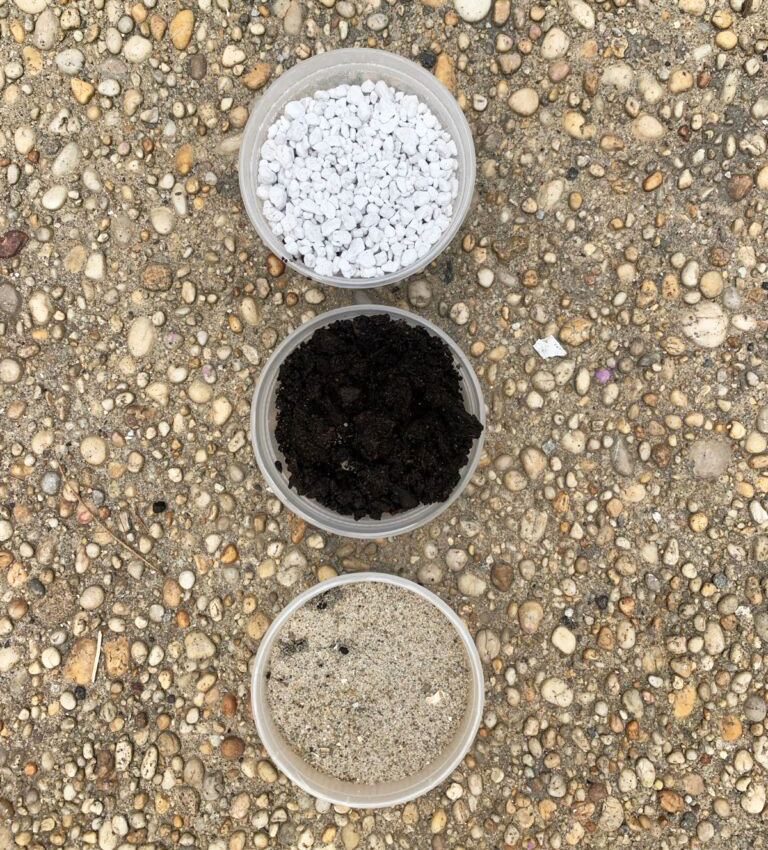
- Soil is important. Use a cactus mix which you can buy at the garden center or this low-cost soil recipe: 2.5 cups of soil, 1 cup of coarse sand (we have plenty of that), and 1 cup of perlite.
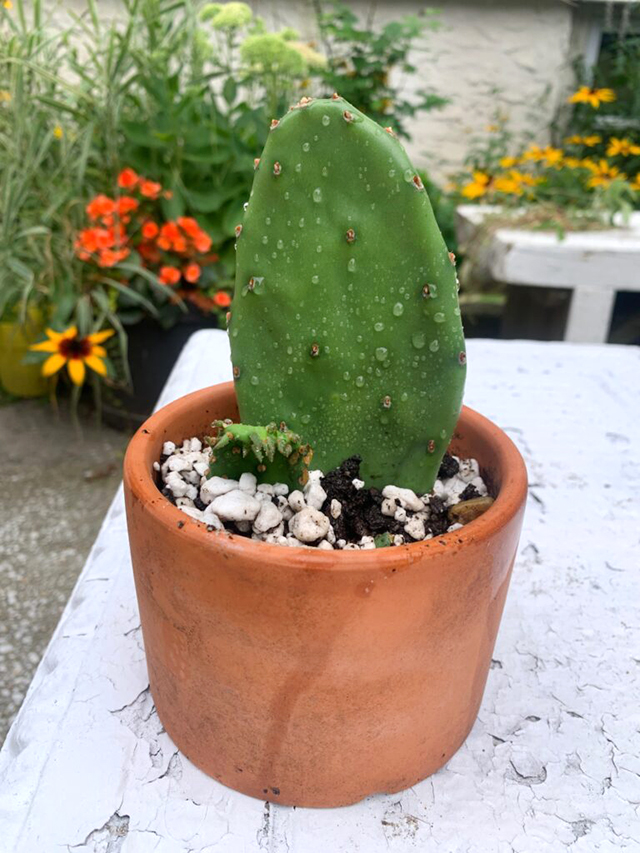
- Plant! Choose a container with drainage holes. Fill the pot with ⅔ soil mix. Place the prickly pear(s) upright in the pot and use a spoon to add more soil mix on top. Pat the soil until the pad is sturdy in place.
- Water the pot thoroughly. After one week give the pad a tug. If it feels secure with resistance, your plant has rooted! The rooting process may take up to two weeks. A misconception is to water cacti scarcely. The proper watering regiment is this: saturate the container (must have drainage) once every 2-3 weeks. Leave the cactus to dry out completely before the next watering.
Prickly Pear can live indoors or outdoors in pots or in the ground. Take your pots inside in the late fall to enjoy these plants year-round. Integrate into your home decor for a fun southwestern vibe! Prickly Pear needs a south-facing window with plenty of sun.
As mentioned above, prickly pear is an agricultural crop. Yup, they’re edible! Often cocktails are made with sweet fruit. I’ve seen prickly pear in Key Food by the refrigerated produce. They can be eaten raw or cooked. I think it’s about time I try a recipe using this unique food, stay tuned for that…
Follow Paula in the field on Instagram @theglorifiedtomato.
It’s like dancing in the ocean. Movements in synchronicity with the water – in part controlled by your body and part guided by the rhythm of the ocean. The music blends with the sounds of the waves, birds and planes. If this connection to nature intrigues you, join like-minded swimmers in our community tomorrow, Saturday, July 23rd on Beach 94th Street for the first of five synchro swimming workshops.
Artist Ritta Ikonen is the organizer who conceptualized this project. She shares the details:
Synchronized Sea Swimming Club is a series of five free performance workshops where anyone can take part in performances and routines that are in sync with Rockaway’s most formidable neighbor, the Atlantic Ocean.
Recognized and celebrated as the all-encompassing force across cultures and times, the sea will act as the main protagonist throughout the project, connecting humans with their surroundings and their respective cultural expressions.
Success is measured by finding harmony with the Atlantic Ocean. Anyone, regardless of background, status, or orientation can join in for free, for one or all of the workshops.
Immersing yourself in seawater, your whole body understands things your eyes never will. One may experience relief by being held entirely by a living mass, an ocean larger and more primal than what we frequently perceive.
The Synchronized Sea Swimming project will begin with a meeting and a presentation with a synchronized swimming coach Kara Gadeker, who will introduce the participants to the basics of the sport and inspire commitment ideally to all workshops. Gadeker, swam competitive synchro in VA for 16 years and has a PhD in marine science. Our other teacher is the land and the sea. Participants will practice various choreography in the water over the five sessions to gain more profound ways of listening and interacting with our surroundings.
Photographers Susannah Ray (@susannahrayphotography) on land and Jena Cumbo (@jenacumbo) in the water will be documenting this project.
What I find most interesting about this interactive swim experience is, unlike the Olympic sport of synchronized swimming, Ritta’s intention is non-anthropocentric. The workshop will focus on our connection as humans to nature. This theme is overarching in all of Ritta Ikonen’s artistic pursuits.
Seachanges, which has become very popular in Rockaway, is a winter artistic swimming practice inspired by Ikonen’s native Finland, where cold water plunges are the norm. Riitta’s goal during the pandemic was to build community during an unprecedented human experience, while connecting us to our natural world. When Riita is not swimming in the sea, she is collaborating on projects such as her work with artist Karoline Hjorth. Eyes As Big As Plates explores the personifications of nature and folkloric traditions in Nordic countries. The duo’s work consists of one hundred plus stunning portraits where humans are integrated into natural environments throughout 14 countries thus far.
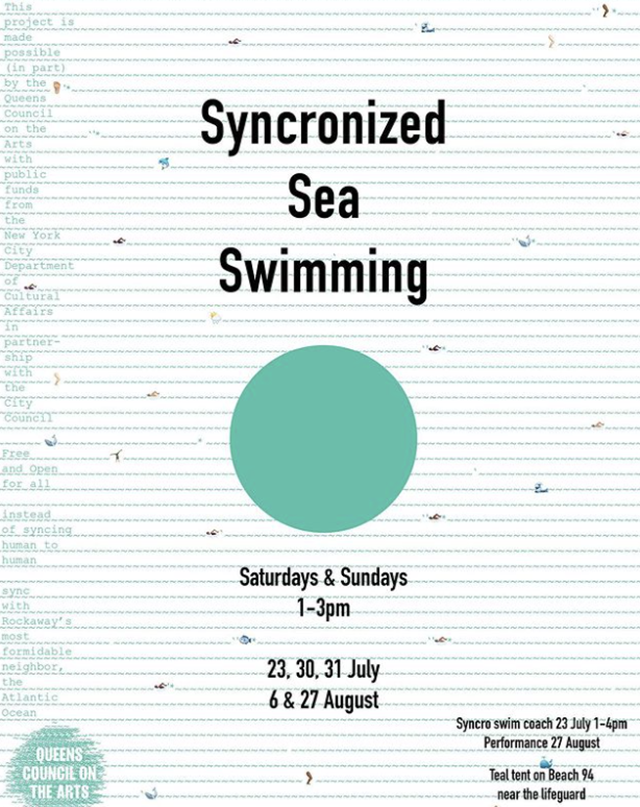
Join the synchronicity! The first swim is tomorrow, Saturday, July 23 from 1-4pm. Additional sessions:
July 30 & 31, 1-3pm
August 6, 1-3pm
August 27, 1-3pm
Swim playlist by Mister Ian Wright (@misterianw) from Do!!You!!! Radio
This project is made possible (in part) by the Queens Council on the Arts with public funds from the New York City Department of Cultural Affairs in partnership with the City Council.
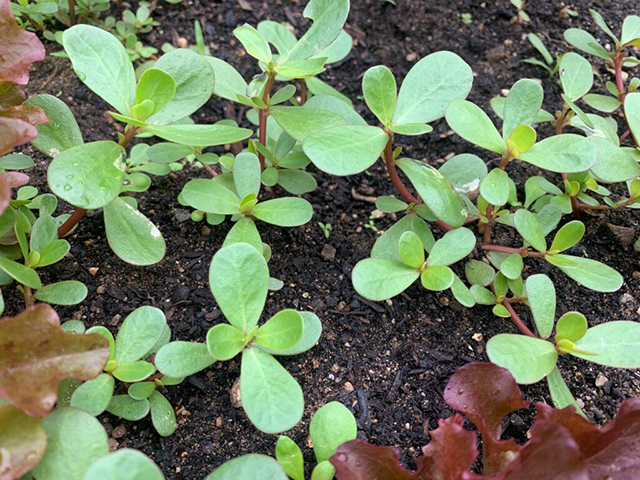 Purslane
I know a great deal about foraging at this point in my gardening “career.” But there’s always more to discover. A few weeks back, I learned of a new edible from my friend Melissa Draugsvold. We were at the Beach 91st Community Garden watering our adjacent plots. She pointed out the purslane that popped up between her lettuce crop.
Purslane (also known as little hogweed, pigweed, pusley) is an annual in our garden zone 7. This succulent can grow in sandy soil and resists drought. You’ll see it everywhere if you look closely – even sprouting out of cracks in the sidewalk. One plant will produce an exorbitant amount of seeds and so, it is here to stay. Purslane has been cultivated since Roman times as a rich food source. But today, due to its vigor, purslane is dumped into the sad category of weeds. But the trend may be changing. My friend Kristi said she saw purslane at a farmers market in Brooklyn selling for 7 bucks a bundle! I guess these folks don’t realize they should just look down to find it for free.
I asked Melissa if I could harvest some of her purslane. Yes, of course, I could! Melissa explained that all parts of purslane are edible – stems, succulent leaves, and yellow flowers. I gave it a taste right there in the garden. It’s tart, salty and juicy. The texture is crunchy!
I went home with my crop and read about this new food find. Purslane is an herb best used fresh but can also be cooked like spinach. Purslane is 93% water. It contains rich amounts of vitamins E and C. It has seven times more beta carotene than carrots! It contains minerals and is a robust source of omega-3 and is low calorie.
Use it like a leafy green. It works well in salads, in lieu of lettuce on a sandwich, atop a taco or layered dip, in smoothies, etc.
An interesting point on harvesting: The plant converts malic acid into sugar as the day progresses. Malic acid is responsible for tartness. If you prefer a more mild flavor, harvest purslane in the early evening. If you like bitterness (bitter is not bad), harvest in the morning. With any foraged food, be mindful of where you’re gathering. Be aware of pesticides, exhaust, dogs, etc.
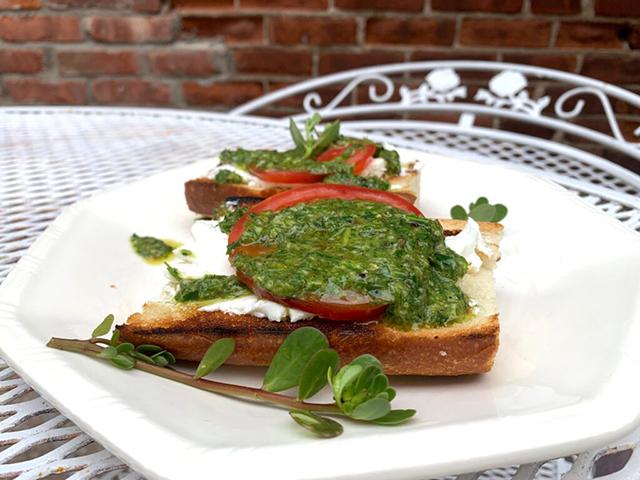
I decided to make a purslane herb spread to use on Italian bread with goat cheese and ripe tomatoes. I added other herbs from my garden for a robust, rich flavor.
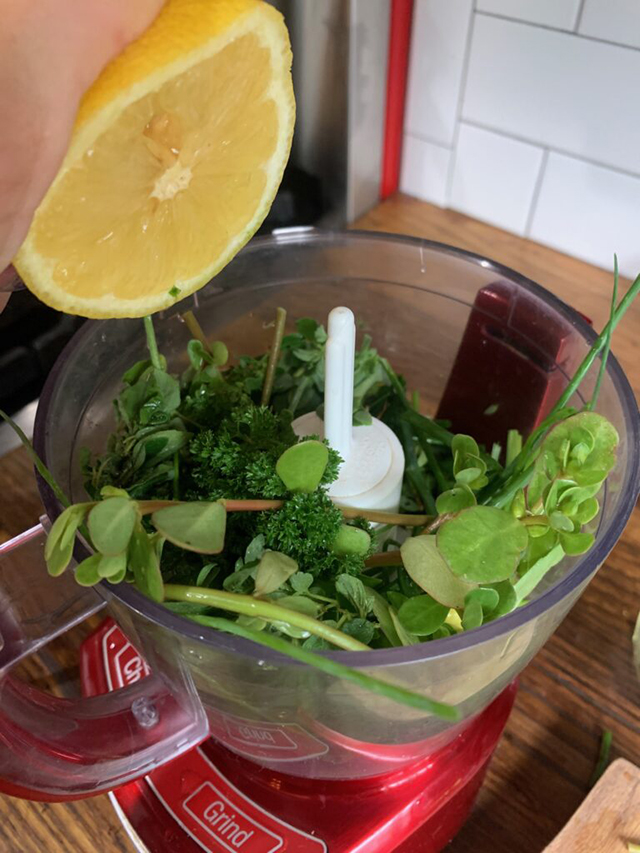
Purslane Herb Spread Over Goat Cheese and Tomatoes
Ingredients for the dressing:
1 1/2 cup extra virgin olive oil
1/2 squeezed lemon
1/2 cup purslane, more for garnish
3 sprigs fresh oregano
4 sprigs fresh parsley
10-15 basil leaves
1-2 ounces of chives
1 clove garlic
Fresh ground pepper, red pepper flakes, and salt to taste
Additional:
Sliced ripe tomatoes
Goat cheese
Italian bread
Directions: Rinse the foraged purslane. Combine all the herbs and the garlic in a food processor with the oil, spices, and lemon. Pulse for 30 seconds. Let the mixture sit for at least one hour before using.
Also, try the purslane herb spread on meats or fish for the grill. It can also be used like pesto on pasta. Enjoy!
The U.S. Department of Agriculture’s Natural Resources Conservation Service has said “Mulching is one of the simplest and most beneficial practices you can use in the garden.” Knowing this, why did I skip mulching this spring? I’m regretting it now. The weeds are a constant in any garden but without mulch, it becomes unmanageable. Every few days it seems the weeds reappear. A 2-3 inch layer of mulch will prevent seeds from planting in the soil. For the relentless roots of weeds, (ahem, morning glories) mulch blocks out sunlight which halts growth.
Another benefit to mulch – water retention. Mulching retains about 80% of the water in your soil. It prevents evaporation, and runoff and stabilizes ground temperature in the heat of the summer and the cold of the winter. With this, gardens that are mulched produce more fruits/vegetables and ornamentals grow bigger and healthier.
I came across an interesting article in the NY Times – Why Your Garden Needs Mulch (Assuming You Do It Right). It discusses the concept of “passive composting.” Unlike composting as we know (adding greens, browns, turning, etc.), using mulch mirrors the natural process of soil enrichment on forest floors. And it’s easier. Passive composting happens when saprophytes organisms such as fungi, bacteria, protozoa, nematodes, and earthworms digest and break down mulch.
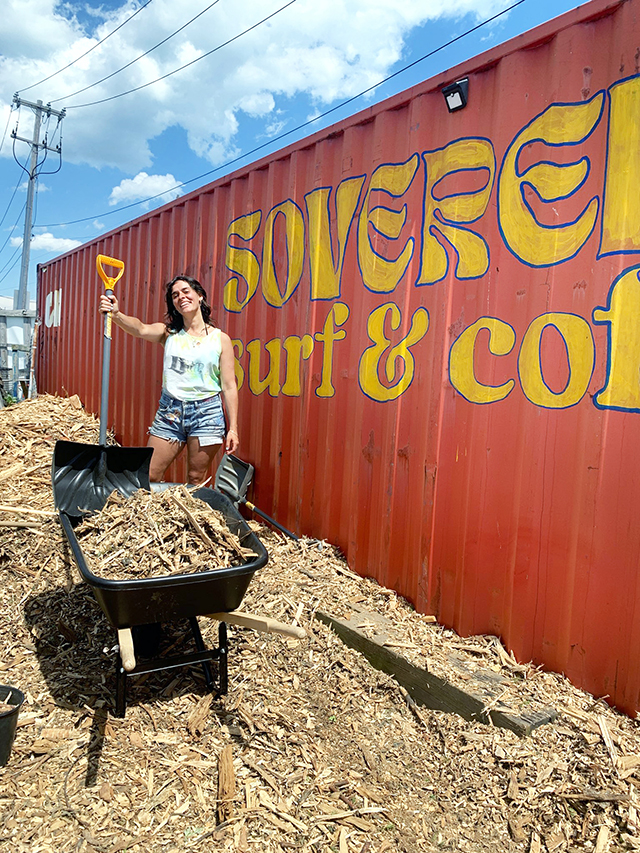 Teresa Farrell understands the benefits of mulching.
What exactly is mulch? We mostly associate mulch with wood chips. In actuality, it is defined as – covering your soil with a protective layer. Mulch can be brown paper bags, newspapers, twigs, bark, leaves, straw, and tall grasses.
The article points out that most of us (and our landscaping services) mulch the wrong way – for aesthetic purposes. Hey, I get that but we can find a balance. Try collecting garden debris throughout the year for the most natural form of mulch. Come fall, leave expended organic material under your trees/shrubs throughout the winter. If possible, keep this material as your mulch in the spring. If you do remove it for aesthetics, wait until the middle of May. Not only will it grow soil, but this natural layer is also home to many important insects that benefit your garden.
Learning about the rewarding benefits of mulch is a step in understanding your garden and its natural functions. Mimicking the inherent process, think “forest floor” is best for your garden and the ecosystem it supports. Remember, your garden is an interconnected natural organism that knows what it needs to do. Your job is simply to finesse it along.
If you don’t have homegrown mulch at this point in the season, visit our local garden center for bagged mulch. (Lisena Garden Center, 12-5 Cross Bay Blvd,). If you need to cover ground, contact tree pruning services. They will most times give and deliver mulch material for free as it costs them money to dispose of it. In fact, Sovereign Surf & Coffee (111-30 Beach Channel Dr.) did just that a few weeks ago. Terence McNicholas, co-owner of the bayside surf cafe, had a 25 cubic yard truck load delivered to use at the outdoor cafe for weed prevention. And it looks fantastic! He had a mound leftover so on Instagram (@sovereign_surf), Terence announced a community mulch giveaway. My friend Teresa reached out. It was perfect timing. I’m helping her build a brand new garden at her home and the mulch from Sovereign Surf was hugely helpful.
However you get your hands on mulch, it’s not too late to lay it down this season. Your garden will thank you with abundance and beauty.
For the day-to-day follow Me in Rockaway on Instagram – @theglorifiedtomato.